John of John by Douglas Stuart

Our July Read - By Alex Latte
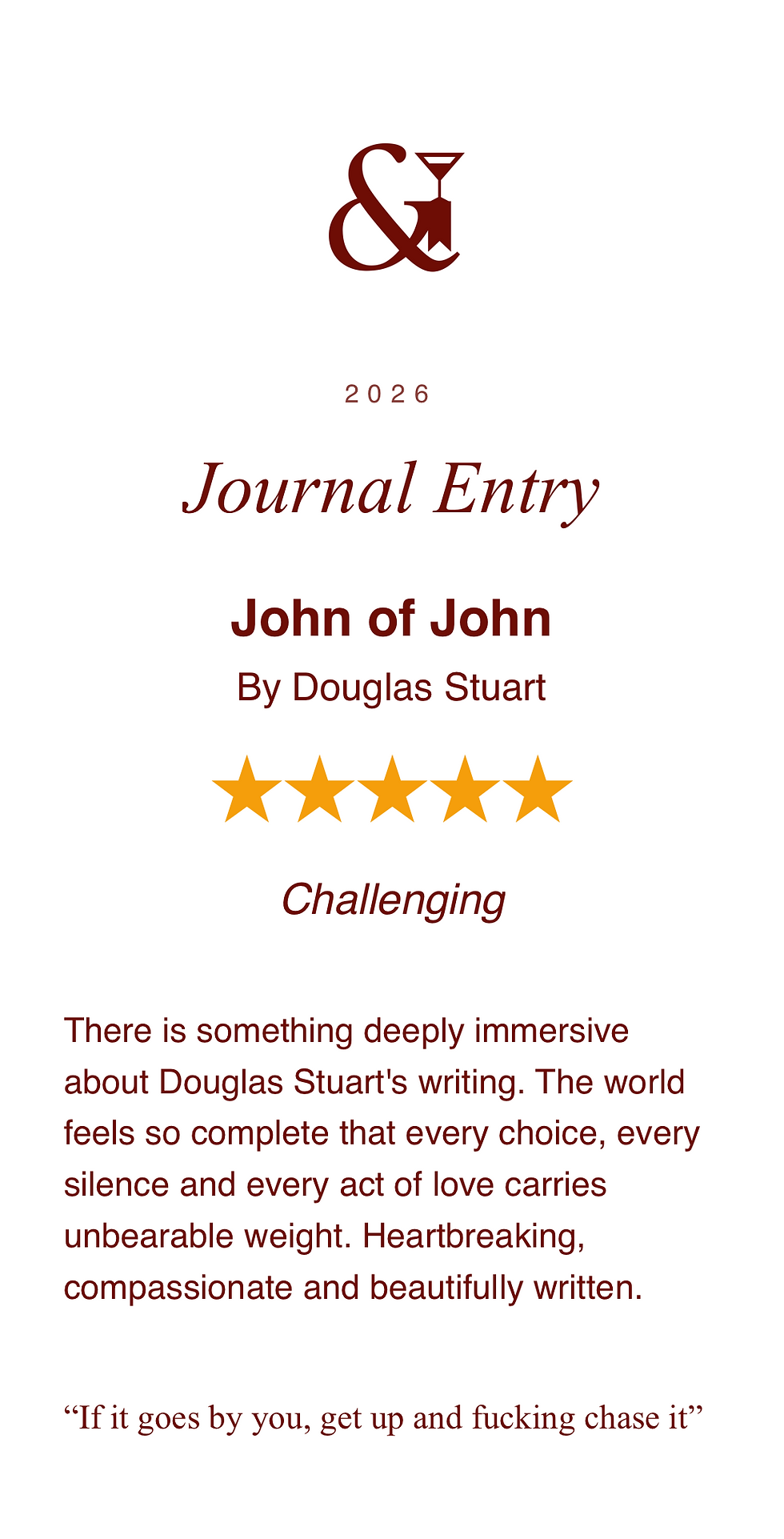
Reading John of John felt, at times, like reopening a wound I thought had long since healed.
I grew up in the Protestant church, and although every person's experience is different, there were moments in this novel that felt painfully familiar. Stuart captures what it is like to grow up in an environment where the expectations for your life are already written before you've had the chance to discover who you are.
You spend so much of your life believing that your worth depends on meeting those expectations, and when you cannot, through no fault of your own, you begin to believe you are the failure.
The novel explores that impossible choice so many people have had to make: stay and become the version of yourself that everyone else can accept, convincing yourself it is redemption, or leave in search of peace, knowing you may lose people, places and a version of life you desperately wanted to belong to. Neither path is painless.
What struck me most is that the book never turns anyone into a simple villain. Even those who seem to fit within those invisible rules are carrying their own burdens. They, too, are sacrificing parts of themselves to maintain a version of acceptance. It is a powerful reminder that rigid expectations rarely leave anyone truly free.
One of the characters who stayed with me most was Ella. She is often treated as though age has made her oblivious to what is happening around her, almost as if she is getting away with things unnoticed. Yet I found her to be one of the most perceptive people in the story. She sees far more than anyone gives her credit for. It reminded me that we often believe we are hiding parts of ourselves, when in reality the people who truly love us usually know far more than we think. Sometimes the only person we are fooling is ourselves.
This is not an easy book. If your relationship with faith, identity or family has ever left scars, the first half may feel as though it pushes the blade a little deeper. But somewhere along the way, almost without you noticing, it begins to heal that wound. It offers the quiet hope that life does not end where someone else's expectations begin.
By the final pages, what stayed with me wasn't only the grief. It was the reminder that choosing yourself is not selfish. That love should never require you to become someone else. And that living honestly, despite the cost, is the only way any of us can truly find peace.
One thing I found myself doing while reading was building a Spotify playlist that matched the atmosphere of the novel. The landscape, the quiet moments, the tenderness and the ache of it all felt as though they deserved a soundtrack. If you'd like to listen along, I'll leave the link below. The song that came to define the book for me is "Lonely Island" by Amble.
Somehow it captures the same quiet loneliness, longing and hope that runs through every page. I'd love to know what you think of the playlist and the book, and whether the music changes the experience of the book for you too.
For me, this is a five-star novel. Lyrical, devastating and profoundly human. It is one of those rare books that leaves you emotionally exhausted while somehow making you feel lighter by the end.

Comments